


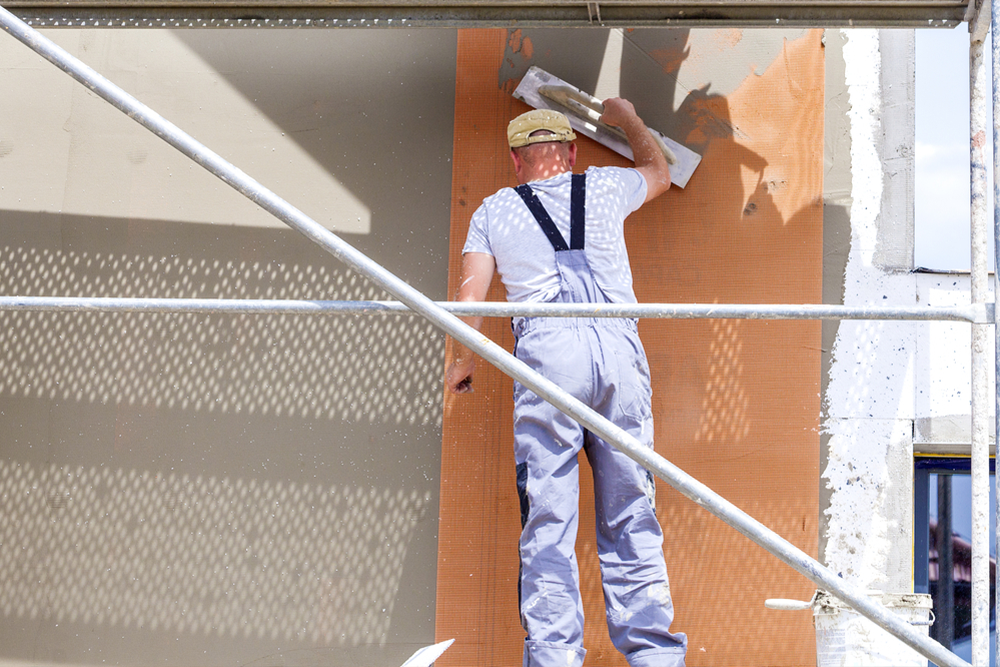
Jacketing adhesive is a cement-based, fiber-reinforced, special adhesive that allows thermal insulation boards to be easily glued to surfaces such as concrete, brick, plaster, aerated concrete, and it is also often used in jacketing repairs.
Moreover, it is also often a preferred adhesive for bonding many knitting and ornamental products such as brick, fire brick, Ytong.
What Are The Features Of Jacketing Adhesive?
The jacketing adhesive has many features. These features can be summarized as follows;
- It ensures strong adhesion of heat insulation boards to many mesh and ornamental products to the surfaces such as bricks, fire bricks and Ytong.
- It has a long application time.
- In addition to being resistant to external weather conditions, it also has water vapor permeability and is a very important substance with this property.
- It fully adapts to the surface to which it is applied, and because the fiber in it has the ability to absorb stresses and vibrations caused by temperature differences, cracking and shedding do not occur thanks to special additives.
How Should The Surface On Which The Jacketing Adhesive Will Be Applied Be?
The surface on which the jacketing adhesive will be applied must have a clean, dry and structurally sound dust-free and oil-free structure.
How to Prepare Mortar for Jacketing Adhesive?
During the preparation of the mortar of the jacketing adhesive, the ready-made powder mixture in the bag should be mixed with a low-speed mixer until it becomes lump-free with 5,5 to 6,5 liters of clean water and should be mixed again after resting for 5 minutes. For application consistency, it is necessary to add water again and mix if necessary. In addition, the prepared mortar should be consumed within 2 to 2.5 hours depending on the weather conditions. Because hardened or solidified material cannot be used.
How Is Jacketing Adhesive Applied?
The adhesive mortar on the surface of the thermal insulation boards to be applied is glued to the solid surface. 4 to 5 cm strips are applied to the edge areas of the surface to be glued to the plate, and 3 to 4 pieces of bonding mortar are applied pointedly to the trowel size at equal intervals to the middle area. After this process, the adhesive is stripped from the surface and the mortar is applied to the stripped areas again.
The thickness of the adhesive to be applied depends on the smoothness of the bottom floor. In this way, the prepared plate is glued to the prepared surface with a light pressure. The joints of the insulation board should not overlap and the application temperature should be at least +5 degrees Celsius. The product must be protected from frost until it is set. Drying time can last about 1 day at 50% relative humidity at +23 degrees Celsius. However, full drying takes between 3 and 4 days. Thermal insulation boards can be anchored 24 hours after gluing and can be applied to their upper surfaces with plaster mortar. In addition, the tools used in the application should be cleaned with water.
Kimteks products include Vinavil SL 11P, Vinavil 5603 PB, Vinavil E06 PA, Vinavil 5603 P, Vinavil 5605 HP, Vinavil 5526, Headcel S5027, Headcel S2016, Headcel N7143, Headcel M6011.


